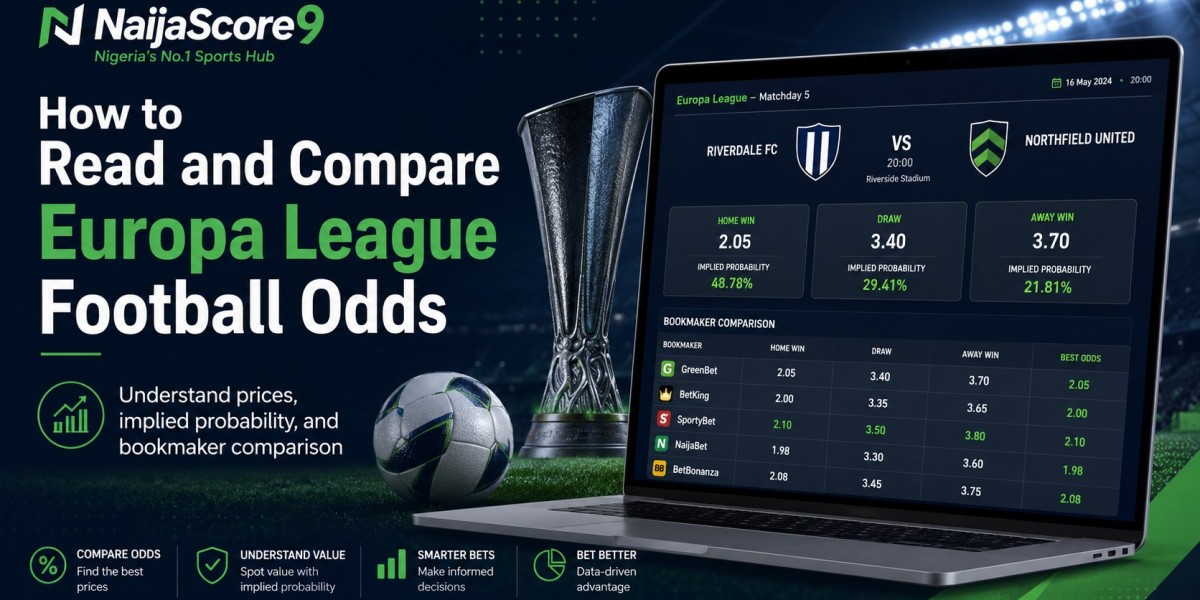


How to Read and Compare Europa League Football Odds
The UEFA Europa League can create some of the most difficult football markets to assess.
Unlike a domestic league, where teams operate in relatively familiar environments, Europa League fixtures often bring together clubs from different countries, playing styles and competitive levels. A strong Premier League side may face an opponent from Serie A, La Liga, the Bundesliga or a less familiar European competition. Knockout ties can add another layer because the score from the first leg may influence how both teams approach the return fixture.
For anyone comparing Europa League football odds, simply identifying the favourite is therefore not enough.
The more useful approach is to understand what the odds represent, compare prices across relevant markets and then decide whether those prices reasonably reflect the match conditions.
This guide explains how to read Europa League odds and what football fans should consider before comparing one price with another.
Start by Understanding the 1X2 Europa League Odds
The standard match-result market is usually displayed as:
1 — Home Win
X — Draw
2 — Away Win
Imagine a Europa League fixture priced like this:
| Outcome | Decimal Odds |
|---|---|
| Home Win | 1.90 |
| Draw | 3.60 |
| Away Win | 4.20 |
The home team is the market favourite because it has the lowest odds.
However, those numbers tell you more than which team bookmakers expect to perform better.
They can also be converted into implied probability.
For decimal odds, the calculation is:
Implied Probability = 1 ÷ Decimal Odds × 100
Using the example above:
1.90 → approximately 52.6%
3.60 → approximately 27.8%
4.20 → approximately 23.8%
This gives you a clearer picture of how the match is being priced.
Remember That Bookmaker Probabilities Include Margin
If you add those percentages together, you get more than 100%.
That is normal.
Bookmakers generally include a margin in their odds. This is sometimes called the overround, vig or bookmaker margin.
Using our example:
52.6% + 27.8% + 23.8% = approximately 104.2%
Only one of the three outcomes can occur, so the amount above 100% reflects the bookmaker's pricing margin.
This matters when comparing Europa League odds because the displayed implied probability should not automatically be treated as the exact probability of the outcome.
A price is a market number—not a guarantee.
Compare the Same Market Across Different Bookmakers
One of the simplest ways to compare football odds is to look at the exact same selection across several bookmakers.
Suppose the home team is available at:
Bookmaker A — 1.78
Bookmaker B — 1.85
Bookmaker C — 1.95
The football outcome required is identical.
But the price is different.
If a hypothetical ₦10,000 stake wins, the total potential return would be:
1.78 → ₦17,800
1.85 → ₦18,500
1.95 → ₦19,500
The difference between the lowest and highest price is ₦1,700.
That demonstrates why odds comparison matters.
If you have already decided that a particular market deserves consideration, accepting a weaker price unnecessarily reduces the potential return.
Do Not Compare Odds Without Comparing Probability
A larger decimal number is not automatically better.
Suppose two Europa League selections are available:
Team A to win — 1.60
Team B to win — 2.40
The 2.40 price offers a larger potential return.
But it also represents a much lower implied probability.
Approximately:
1.60 = 62.5%
2.40 = 41.7%
The correct question is therefore not:
Which bet pays more?
It is:
Does the price reasonably reflect how likely I believe the outcome is?
This relationship between odds and probability is central to sensible football-market analysis.
Europa League Home Advantage Needs Context
Home advantage can matter in European football, but it should not be assumed automatically.
A club may have an excellent domestic home record while facing a much stronger European opponent than it normally encounters.
Similarly, travelling conditions, crowd support and familiarity with the stadium may help the home side without necessarily making it the better team.
When comparing home-win odds, consider:
the quality of the opposition;
home performance in European competition;
the team's general home form;
whether the opponent travels well;
possible squad rotation.
Do not rely on the word “home” alone.
Pay Attention to the Stage of the Competition
Europa League odds should also be interpreted according to the tournament situation.
A league-phase match is different from a knockout second leg.
Suppose Team A won the first leg 3-0.
In the second leg, Team A may not need to attack aggressively.
The opponent, however, has little choice but to chase goals.
That can affect several markets, including:
match result;
Over/Under Goals;
BTTS;
handicaps;
team goals.
A bettor looking only at the relative quality of the two teams could miss the importance of the aggregate score.
In European knockout football, what each team needs from the match can be just as important as which team is stronger.
Qualification Odds and Match Odds Are Different
Another common mistake is confusing match-result markets with qualification markets.
If you back:
Team A to win
you are usually betting on the result of that individual match according to the bookmaker's settlement rules.
If you back:
Team A to qualify
you are betting on whether Team A progresses from the tie.
A club can lose the second leg and still qualify because of its first-leg advantage.
For example:
First leg: Team A wins 3-0.
Second leg: Team A loses 1-0.
Team A loses the match but progresses 3-1 on aggregate.
Always check exactly what market you are comparing.
Examine Over and Under Goal Odds Separately
Europa League matches can produce very different tactical environments.
Consider:
Over 2.5 Goals — 1.80
Under 2.5 Goals — 2.00
These odds suggest the market considers three or more goals slightly more likely than a match containing two or fewer.
But before accepting that assessment, examine how the teams actually play.
Useful information can include:
recent scoring frequency;
goals conceded;
home and away patterns;
clean sheets;
attacking quality;
defensive injuries;
first-leg score where applicable.
Do not assume a match involving two famous attacking teams must automatically produce Over 2.5 Goals.
European knockout football can sometimes encourage more cautious tactics.
Compare BTTS With Total Goals
Both Teams to Score and Over 2.5 Goals are closely related but should not be treated as the same market.
Consider:
1-1
BTTS Yes wins.
Over 2.5 Goals loses.
Now consider:
3-0
Over 2.5 Goals wins.
BTTS Yes loses.
When analysing Europa League odds, determine whether you expect:
both teams to contribute, or simply the match to contain several goals.
A dominant favourite against a weak defence might support Over 2.5 without making BTTS especially attractive.
Two evenly matched attacking teams may create a stronger BTTS argument.
Understand Asian Handicap Prices
Asian Handicap markets can be particularly useful in matches where there is a clear favourite.
Instead of backing a team simply to win, you may see:
Favourite -0.5
Favourite -1.0
Favourite -1.5
The line changes what the team must achieve.
For example:
Favourite -0.5
The favourite must win.
Favourite -1.0
A two-goal victory produces a full win.
A one-goal victory normally produces a refund.
Favourite -1.5
The favourite needs to win by at least two goals.
Naturally, a more demanding handicap usually comes with a larger price.
The question is whether the expected winning margin justifies that additional requirement.
Check Domestic Form, but Do Not Copy It Directly Into Europe
Domestic league performance matters.
But Europa League football may present a very different challenge.
A team dominating its national league may face a much higher standard of opposition in Europe.
Likewise, a club struggling domestically may approach the Europa League differently, especially if European progress has become a major priority.
Recent form should therefore be examined alongside:
quality of opponents;
strength of domestic competition;
European experience;
available squad;
fixture schedule.
A five-match winning streak does not automatically mean the same performance level will carry into Europe.
Squad Rotation Can Move Europa League Odds
European fixtures often arrive between domestic matches.
Managers may rotate because of:
league priorities;
injuries;
congested schedules;
upcoming derbies;
first-leg advantages.
A team priced as a strong favourite based on its usual starting eleven may become less attractive if several important players are rested.
This is one reason Europa League prices can change as kickoff approaches.
Confirmed or expected line-ups may cause the market to reassess the fixture.
When possible, compare the original analysis with the most recent team information before relying on an earlier price.
Watch for Odds Movement, but Do Not Follow It Blindly
Imagine a home team opens at:
2.20
Later, the price moves to:
1.95
The market has clearly changed.
This may reflect:
team news;
player availability;
betting activity;
updated information;
bookmaker adjustments.
The movement is worth noticing, but it does not tell you with certainty that the home side will win.
Instead, ask why the price may have moved and whether the new odds still make sense.
A good price at 2.20 may no longer be equally attractive at 1.95.
Compare Predictions With Market Odds
Football predictions can offer another reference point when analysing Europa League prices.
Suppose a model estimates:
Home Win — 56%
and the bookmaker offers:
2.00
Odds of 2.00 imply 50%.
The model and market are not aligned.
That does not automatically mean the home selection offers value. The prediction could be wrong, and bookmaker margin also matters.
But the difference gives you something to investigate.
Fans can use NaijaScore9 football predictions as one source of probability-based analysis when evaluating how football-market prices compare with expected outcomes.
Predictions should support analysis rather than replace it.
Compare More Than the Match Winner
Europa League fixtures may offer many markets worth analysing.
These can include:
1X2;
Double Chance;
Draw No Bet;
Asian Handicap;
Both Teams to Score;
Over/Under Goals;
team goal totals;
qualification markets;
correct score;
corners;
cards.
Rather than deciding that one team will win and forcing the analysis into the 1X2 market, first consider how you expect the match to unfold.
A team may be stronger without necessarily being attractive at short match-win odds.
In another fixture, the clearest difference may be defensive weakness rather than the likely winner.
The market should match the football analysis.
Use Odds Tools to Make Comparison Easier
If you regularly compare football odds, calculations can become repetitive.
Betting tools can help answer questions such as:
What probability does this price imply?
How different are two bookmakers' prices?
What happens when bookmaker margin is removed?
NaijaScore9 provides betting tools that can help users understand odds conversion, implied probability and other mathematical concepts connected with football prices.
These tools do not identify guaranteed bets.
Their role is to make the numbers easier to interpret.
A Practical Europa League Odds Comparison Process
When researching a match, try this sequence:
1. Understand the Fixture
Identify whether it is a league-phase or knockout match and, where relevant, understand the aggregate situation.
2. Form a Football View
Consider team quality, recent form, venue and probable tactical approach.
3. Check Team Availability
Look for significant injuries, suspensions and potential rotation.
4. Review the Available Markets
Do not restrict yourself automatically to the match winner.
5. Convert Odds Into Probability
Understand what each bookmaker price implies.
6. Compare Bookmakers
Check whether the same selection is available at a stronger price elsewhere.
7. Compare Market Probability With Your Analysis
Look for meaningful differences, but remain realistic about the uncertainty of your own estimate.
8. Recheck Closer to Kickoff
Team news or odds movement may have changed the original assessment.
Common Mistakes When Comparing Europa League Odds
Beginners frequently make several avoidable errors.
Choosing the Famous Team Automatically
Club reputation does not determine whether the current price is attractive.
Looking Only at Potential Return
Higher odds correspond to lower implied probabilities.
Ignoring the Tie Situation
A second-leg match can produce very different tactics from an ordinary league fixture.
Comparing Different Markets as if They Were Identical
“Team to win” and “Team to qualify” are not the same bet.
Ignoring Rotation
European schedules often create significant squad-management decisions.
Treating Odds Movement as a Prediction
A shortening price tells you the market has changed—not that the result is guaranteed.
Final Thoughts
Reading Europa League football odds properly involves much more than choosing the lowest-priced favourite.
Start by understanding what the market actually represents. Convert the odds into probabilities, consider bookmaker margin and compare the same selection across different bookmakers.
Then bring the football context into the analysis.
Look at team strength, home and away performance, the stage of the competition, aggregate score, squad rotation and current team news. A Europa League second leg where one side already leads comfortably should not be assessed in exactly the same way as a league-phase fixture where both clubs need a result.
Most importantly, separate predicting the match from evaluating the price.
A team can be the most likely winner and still be unattractive at the available odds.
The more useful question is not simply:
Who will win this Europa League match?
It is:
Does the price being offered accurately reflect the probability and match conditions I am analysing?
That is the foundation of reading and comparing Europa League football odds more intelligently.









